
Sellers' Guide
Selling a Flat With Damp, Condensation or Mould
Buyers notice damp straight away, but few understand it. In a flat the cause often lies outside your own walls, so the first step is to work out which kind of damp you have and who has to fix it. This guide explains the three causes, who is responsible, how surveyors and lenders react, what repairs cost and how each situation affects the price.
Can You Sell a Flat With Damp or Mould?
Mould in the corner of a bedroom, a tide mark above the skirting or a patch on the ceiling that comes back every winter: these are the things a buyer's eye goes straight to at a viewing, and the things a surveyor's damp meter finds even when they have been painted over. Most damp is cheap to fix once the cause is known. The trouble is that three very different problems look alike on the wall, and only one of them is usually yours to put right.
This guide helps you work out which kind you have, whose responsibility it is, what the fix costs and how to present it so that a buyer sees a known, bounded problem rather than an open question. If the flat has wider condition problems, our page on selling a flat in poor condition covers the bigger picture.

This guide is general information, not legal or surveying advice. It covers England and Wales.
Written and kept up to date by the Sell Flat UK team at LDN Properties Ltd, who have bought flats with damp and mould problems since 2003. Last reviewed on 14 October 2026.
The Three Kinds of Damp, and How to Tell Them Apart
Everything that follows depends on which of these you have. They are often confused, and damp treatment firms that sell one kind of cure have a habit of finding that kind of problem.
Condensation
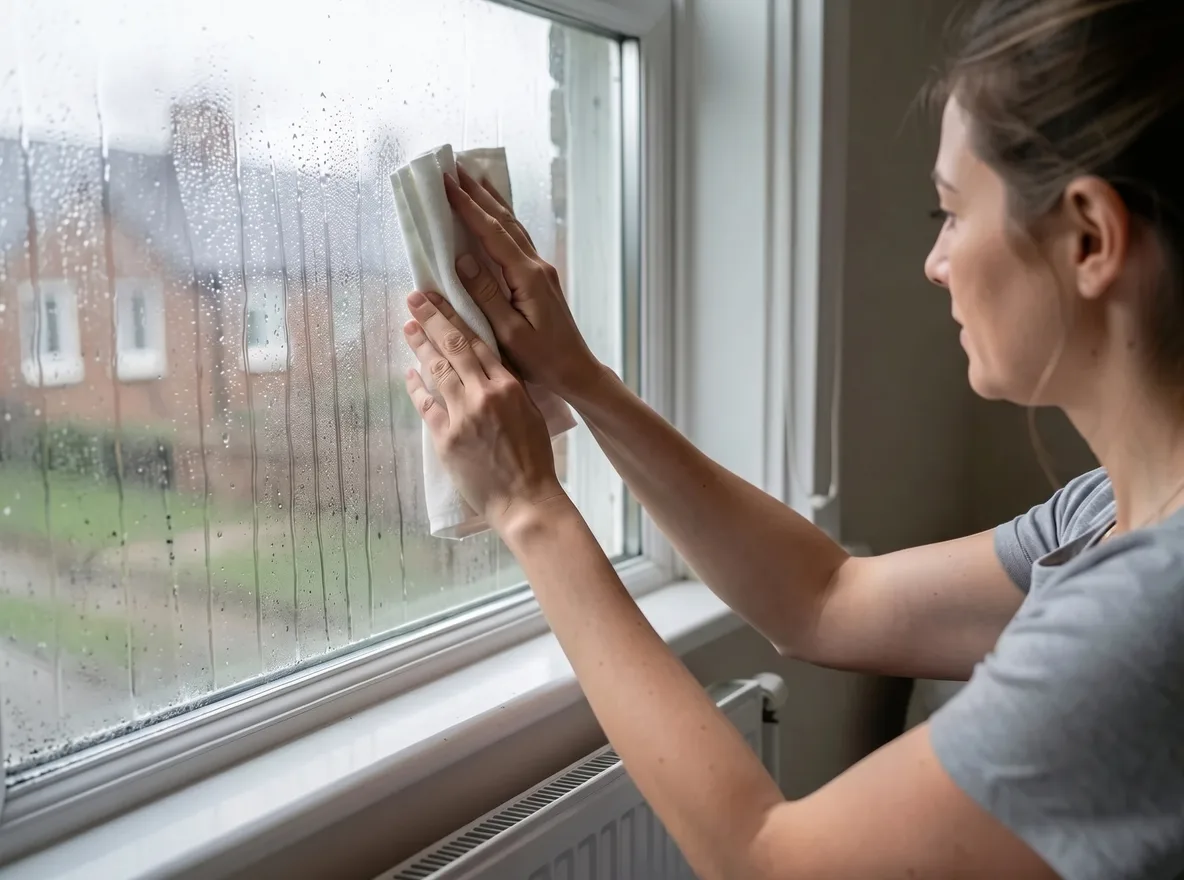
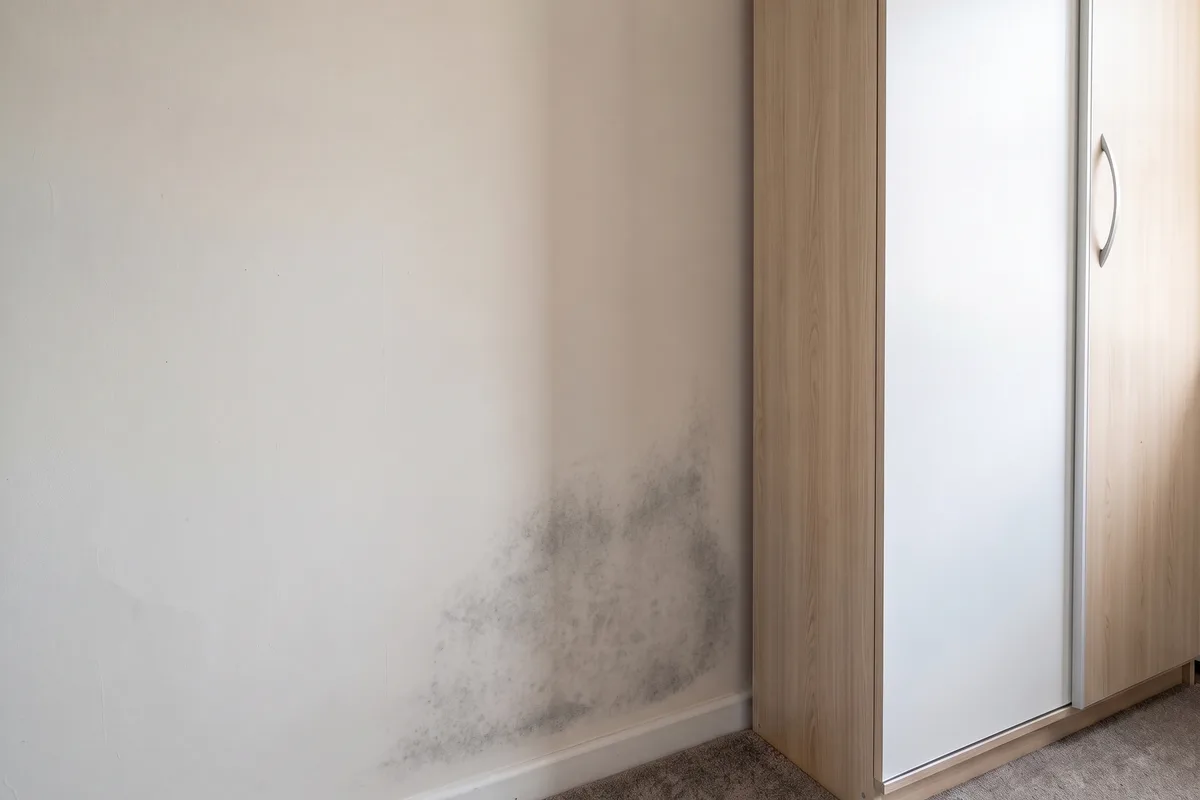
By far the most common, and the one most often blamed on something else. Warm, moist air from cooking, showers and drying clothes hits a cold surface and turns to water. The signs are black spot mould in the corners of rooms, on cold outside walls, behind wardrobes and around windows, streaming windows on winter mornings and a musty smell. It is worse in winter, worse in rooms that are kept cold and worse where trickle vents are shut and extractor fans do not work. The cure is ventilation and heat, not injections into the wall.
Penetrating damp
Water getting in from outside or from a neighbour. On the top floor it is usually the roof, a parapet gutter or flashing. On any floor it can be failed pointing, a cracked render, a blocked downpipe or a window seal. In a flat the most common source of all is the flat above: a bath overflow, a failed shower seal or a weeping pipe. Penetrating damp shows as a defined patch that gets worse after rain or after the upstairs neighbour's shower, often with a stain ring around it, and it can appear at any height on the wall or ceiling.
Rising damp
Ground water drawn up through the brickwork because the damp-proof course has failed or been bridged by a raised path or a flower bed. It only affects ground-floor and basement flats, it rarely rises above about a metre and it leaves a tide mark with white salt deposits as the water evaporates. It is diagnosed far more often than it occurs. A surveyor's meter reading alone does not prove it, and many cases turn out to be condensation, a leaking pipe or a bridged course that just needs the path lowering.
A quick test
Worse in winter, in corners and behind furniture, with black spots: condensation. A single patch that changes with the weather or with the neighbour's bathroom: penetrating damp or a leak. Ground floor only, a tide mark with salts, no higher than a metre: possibly rising damp, but check for a leak first. If you are not sure, an independent damp surveyor with no products to sell will tell you for around £150 to £400.
Who Is Responsible in a Flat?
This is where a flat differs from a house. Your lease sets out what you own and what the freeholder keeps. In most blocks the freeholder is responsible for the roof, the outside walls, the gutters, the structure and often the window frames, and recovers the cost of repairs from all the leaseholders through the service charge. You are responsible for the inside: plaster, decoration, your own pipes and fittings. Our guide to selling a flat with structural problems explains the same split in more detail.
Match that to the three causes and the picture is usually clear:
| Cause | Usually responsible | Who pays |
|---|---|---|
| Condensation | You, as the occupier, unless a defect in the building is causing it, such as a cold bridge or a failed extractor the freeholder installed | You |
| Penetrating damp from the roof, walls, gutters or windows | The freeholder or management company, under the repairing covenant in the lease | All leaseholders through the service charge, or the block's buildings insurance if the damage is sudden |
| A leak from the flat above | The owner of that flat for the leak itself; the block policy for the damage to yours | Usually the buildings insurance, with the excess falling on the flat where the leak started, depending on the lease and policy |
| Rising damp | The freeholder, as the damp-proof course is part of the structure | All leaseholders through the service charge |
Insurance matters here. The block's buildings insurance almost always covers escape of water, so a burst pipe or an overflowing bath upstairs is usually a claim. It almost never covers condensation, gradual seepage or a roof that has been leaking for years, which are treated as maintenance and fall to whoever is responsible under the lease.
If the freeholder will not act
A freeholder who is responsible for the roof and does nothing is in breach of the lease, but enforcing that takes months. Report the problem to the managing agent in writing, with photographs and dates, so that there is a record the buyer's solicitor can see. If nothing happens, our guide to dealing with a difficult managing agent sets out the next steps. For a sale, the written trail matters as much as the repair: it shows a buyer that the problem is known, reported and someone else's to fix.
How Buyers, Surveyors and Lenders React
At the viewing
Buyers smell damp before they see it. A musty room, streaming windows or a sofa pulled away from a mouldy wall ends many viewings before the kitchen. First-time buyers, who make up a large share of flat buyers, are the most nervous, partly because they have read about the health risks and partly because they have no spare money for repairs.
The survey
A RICS Level 2 or Level 3 survey includes a damp meter reading on the walls and a condition rating for each element. Visible mould or high readings usually earn a rating of 3, the red "needs urgent attention" grade, and a recommendation that the buyer gets a specialist damp and timber report before exchange. That report normally comes from a Property Care Association (PCA) member. Many treatment firms offer it free and then quote for the work, so expect the quote to be generous. Our guide to responding to the buyer's survey covers how to handle what comes back.
The lender
The lender's valuer sees the same thing. For minor condensation they usually note it and move on. For active damp they can make the mortgage offer conditional on a specialist report, impose a retention so that part of the loan is held back until the work is done and re-inspected, or, where mould is widespread, decline the flat as security altogether. A retention is the common outcome, and it means the buyer has to find the repair money themselves, which comes straight off their offer.
Health and the law
Damp and mould are now treated as a health hazard, not a cosmetic one. Government guidance says mould can cause and worsen breathing problems, and that children, older people and anyone with asthma or a weakened immune system are most at risk. That has fed into Awaab's Law, which since 27 October 2025 requires social landlords to investigate reported damp and mould within 10 working days and make the home safe within 5 working days of the investigation ending. It does not apply to you as an owner-occupier, but it has changed how buyers and their surveyors talk about mould, and the section on let flats below explains why it matters if you have a tenant.
What It Costs to Fix
The repair is usually cheaper than the discount a buyer will take for it. Typical figures from current trade price guides, for work inside a flat:
| Problem | Typical fix | Typical cost |
|---|---|---|
| Condensation mould | Clean the mould, run heating steadily, open trickle vents, replace or add extractor fans in the kitchen and bathroom | £80 to £150 to swap a fan, £350 to £600 for a new ducted one |
| Persistent condensation | A positive input ventilation (PIV) unit, which pushes filtered air into the flat from a loft or hallway and keeps humidity down | £400 to £1,200 installed |
| Penetrating damp | Repair the source: gutter, pointing, seal, flashing or the neighbour's pipe. Then let the wall dry out, which can take weeks, and redecorate | From £200 for a gutter or seal to several thousand for roof or render work, usually on the service charge |
| Rising damp | Chemical injection of a new damp-proof course, then hacking off and replacing the salt-contaminated plaster, which is often the larger cost | £40 to £120 per metre for the injection; commonly £1,500 to £4,000 for the affected walls of a flat including replastering |
Two cautions. Rising damp treatment is sold hard, and injecting a wall that is suffering from condensation or a leak fixes nothing. Get the diagnosis from someone who is not selling the cure. And redecorating before the wall is dry, or before the source is fixed, is money wasted: the stain comes back within a season, usually just after the buyer has moved in.
How Much Does It Affect the Price?
It depends on whether the cause is fixed, whether it was yours to fix and how much of the flat is affected. As a rough guide, from what we see:
| Situation | Typical effect on price | What buyers usually want |
|---|---|---|
| Condensation mould, cause dealt with, cleaned and redecorated | Little or none | To see working extractor fans and a dry, fresh-smelling flat at the viewing |
| Damp inside your demise, diagnosed with a written report and a quote, work not yet done | The cost of the work plus about 5 to 10 percent | The report and quote, and often a price reduction rather than you doing the work |
| Damp from the roof, structure or the flat above, where responsibility or timing is unresolved | About 10 to 20 percent | Evidence the freeholder or neighbour has accepted responsibility and a date for the repair. A lender retention is likely. |
| Widespread mould, rot or a lender that will not lend | About 20 to 30 percent, sometimes more | Most mortgage buyers cannot proceed. Cash buyers price in the works, the drying time and the risk. |
These are typical ranges, not a valuation. The pattern is the one that runs through every leasehold problem: a known cost gets priced in, an open question gets priced in harder. A £600 fan and a tin of paint, done before the first viewing, can move a flat from the second row of that table to the first.
What to Do Before You Go to Market
- Work out which kind of damp it is. Use the quick test above, and if there is any doubt pay for an independent survey. The report is worth having whatever it says, because it is the document the buyer's surveyor will ask for.
- Report anything outside your demise in writing. Email the managing agent with photographs and dates, and keep the replies. If a neighbour's leak is the cause, tell them and the agent the same day.
- Fix what is yours to fix. Fans, ventilation, a PIV unit, a leaking seal under your own bath. These are small jobs with a big effect on how the flat shows.
- Let it dry, then clean and redecorate. Clean mould with a fungicidal wash, not bleach and a scrub, and wait until the wall reads dry before painting. Keep the receipts.
- Gather the paperwork. The survey, invoices, guarantees, the managing agent's correspondence and any insurance claim letters. Give them to your estate agent before the first viewing.
- Disclose what remains. Known damp is material information. The property information form asks about damp-proofing guarantees and insurance claims, and an estate agent must tell buyers about known defects. A buyer who discovers it from the survey usually renegotiates or walks away. One who was told at the viewing rarely does either. Our guide to disclosure mistakes explains where the line falls.
Do not paint over mould or hang a picture over a stain. Surveyors look for fresh paint in corners, meters read through it and a buyer who finds the problem after completion can have a claim for misrepresentation. Do not ventilate the flat for one day before the viewing and shut it up again. Buyers come back.
If the Flat Is Let
Damp in a tenanted flat raises two extra questions. The first is whether the tenant has reported it and what you did about it. Private landlords already have to keep a home fit for human habitation and free of serious hazards, and a tenant who has complained in writing has a record. The second is Awaab's Law. It applies to social landlords now. The government is consulting, from 9 October to 18 December 2026, on extending it to private tenancies, with fixed deadlines for investigating and fixing damp and mould. The earliest that could take effect is 2027, and the government's own impact assessment assumes it will be phased in from 2028.
A buyer who intends to keep the tenant will ask about both. Our guide to renting out your leasehold flat covers the landlord's duties, and our news piece on what the Renters' Rights Act means for leasehold landlords explains the wider changes. If the damp is condensation caused by how the flat is being lived in, say so, but expect the buyer's surveyor to look for a building cause first.
Your Options
| Option | How it works | Best for |
|---|---|---|
| Fix it, then sell through an estate agent | Diagnose, repair, dry out and redecorate, then market the flat with the paperwork ready | Condensation and anything inside your demise. The repair almost always costs less than the discount. |
| Sell through an estate agent with the problem disclosed and priced | Market with the survey and quotes available, and set the asking price to reflect the work | Damp the freeholder has accepted responsibility for, with a repair date, where you do not want to wait |
| Sell at auction | The legal pack and viewings disclose the condition. Most bidders are cash buyers and builders. | Widespread damp or rot where mortgage buyers are unlikely and speed matters |
| Sell to a cash buyer | The buyer inspects once, prices the works in and completes in weeks without a lender's conditions | Unresolved responsibility, a lender refusal, a sale that has already fallen through on the survey |
Fixing first is the right answer more often for damp than for almost any other problem, because the fixes are cheap and the fear is expensive. Where the cause sits with a freeholder who will not act, or the flat has gone beyond a tin of paint, our guides to selling at auction and selling to a cash buyer compare the faster routes, and our page on unmortgageable flats covers flats lenders will not currently take.
Sources and Further Reading
- Government guidance: understanding and addressing the health risks of damp and mould in the home: the causes, the health effects and who is most at risk.
- Consultation: extending Awaab's Law to private rented tenancies: the social-sector timescales in force and the proposals for private landlords.
- Property Care Association: the trade body for damp and timber specialists, and a register of members.
- RICS: the Home Survey Standard and what Level 2 and Level 3 surveys cover.
- Leasehold Advisory Service: free guidance on repairing obligations and service charges.
Frequently Asked Questions
Yes. Damp is one of the most common findings on a flat survey and it rarely stops a sale on its own. What it does is give the buyer's surveyor something to flag, the lender a reason to hold back part of the mortgage and the buyer a reason to renegotiate. Fixing the cause before you market, or diagnosing it and pricing it in, keeps that under control.
Condensation shows as black spot mould in corners, behind furniture and around windows, is worse in winter and comes with streaming glass. Penetrating damp is a defined patch that changes with the weather or with a neighbour's bathroom use. Rising damp only affects ground-floor and basement flats, stays below about a metre and leaves a tide mark with white salts. If you are unsure, an independent damp surveyor who does not sell treatments will tell you for around £150 to £400.
Your lease decides. The freeholder usually repairs the roof, outside walls, gutters and structure, and recovers the cost through the service charge, so penetrating damp from those parts and rising damp are normally theirs to fix. Condensation is usually down to how the flat is heated and ventilated, which makes it yours. A leak from the flat above is that owner's responsibility, with the block's buildings insurance normally covering the damage to your flat.
Rarely for minor condensation. For active damp, the lender's valuer may require a specialist damp and timber report, impose a retention so part of the loan is held back until the work is done and re-inspected, or in severe cases decline the flat. A retention is the most common outcome and it means the buyer has to fund the repair, which usually comes off their offer.
Fix it if it is yours to fix. Fans, a ventilation unit and redecoration after the wall is dry cost hundreds of pounds and remove the problem from the viewing and the survey. Buyers typically take off the cost of the work plus 5 to 10 percent for the trouble, so you are better off doing it. If the cause belongs to the freeholder or a neighbour, you may not be able to, and then the choice is between waiting for the repair and pricing the problem in.
No. Covering a known problem without fixing it is treated as hiding it. Surveyors look for fresh paint in corners and their meters read through it, and a buyer who finds the damp after completion can have a claim for misrepresentation. Clean the mould with a fungicidal wash, fix the cause, let the wall dry and then redecorate, and keep the receipts to show what was done.
If you know about it, you do. Damp is material information. The property information form asks about damp-proofing guarantees and insurance claims, and an estate agent is required to pass on anything that would affect a buyer's decision. A buyer told at the first viewing, with the report and quotes to hand, usually makes an offer that reflects it and sticks. One who finds out from the survey usually renegotiates or walks away.
Condensation that has been dealt with and redecorated makes little difference. Damp inside your demise with a report and a quote typically costs the price of the work plus 5 to 10 percent. Damp from the roof, the structure or the flat above where responsibility or timing is unresolved usually costs 10 to 20 percent. Widespread mould or rot, or a flat a lender will not take, costs 20 to 30 percent or more and narrows the market to cash buyers.
Not if you live in it. Awaab's Law has applied to social landlords since 27 October 2025, requiring them to investigate damp and mould within 10 working days and make the home safe within 5 working days of the investigation ending. The government is consulting until 18 December 2026 on extending it to private tenancies, with 2027 the earliest it could take effect and phasing from 2028 assumed. If you let your flat, buyers who plan to keep the tenant will ask how any damp complaint was handled.
Report it in writing to the managing agent and the owner, with photographs and dates, and ask the agent to raise a claim on the block's buildings insurance for the damage to your flat. The lease usually lets the freeholder require the upstairs owner to repair, and the insurer will often pursue them for the excess. For a sale, the written record is what matters: it shows the buyer the cause is identified and is someone else's to fix. If it drags on, a cash buyer can complete without waiting for the repair.