Type of Property Guide

Selling a Flat in Poor Condition

Structural issues, damp, dereliction or simply a flat that needs a full renovation. There is genuine buyer demand for problem properties. The key is understanding who those buyers are and how they price.

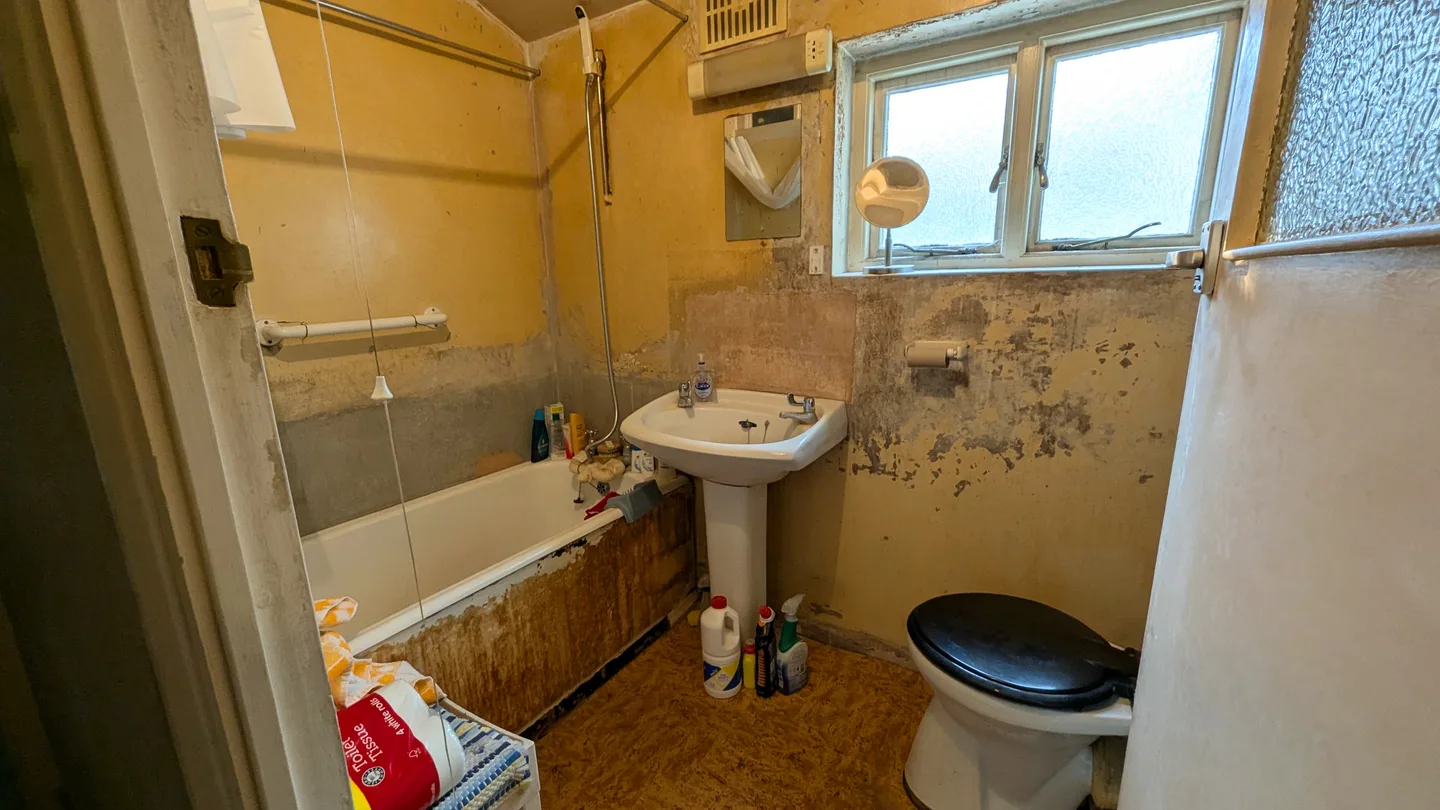
A bathroom in poor condition, with stripped walls, missing tiles and an exposed subfloor

Can You Sell a Flat in Poor Condition?

Yes. Flats in poor condition can and do sell, often more quickly than sellers expect, once they are priced correctly and marketed to the right audience. A conventional estate agency sale (portal listings, mortgage buyers) can work for mildly dated or cosmetically tired properties. But for flats with structural issues, serious damp, dereliction or other significant problems, the effective buyer pool shifts towards cash buyers, investors and developers.

The biggest mistake sellers make with problem properties is pricing them as if the condition does not matter, or spending money on cosmetic improvements that professional buyers ignore. Understanding what type of buyer your flat will attract, and what they need from a price, is the starting point for a successful sale.

This guide covers England and Wales. It explains how to disclose condition issues legally, when to renovate and when not to, how professional buyers value a property and the practical steps you can take to run a clean, honest sale that completes on time. Everything here is general information rather than legal, financial or tax advice: for advice on your own sale, speak to a solicitor.

Selling a flat in poor condition: guide to disclosure, realistic pricing and completing a sale

Types of Poor Condition Flat

The type of problem affects who buys and at what discount. Not all "poor condition" flats are the same.

Structurally Compromised

Subsidence, foundation movement, structural cracks, wall-tie failure or sagging floors. These flats are usually unmortgageable until remediation is complete, which limits the buyer pool to cash buyers who can assess repair costs themselves. A structural engineer's report is valuable; buyers will ask for one, and producing it upfront speeds the process.

Damp, Mould and Water Damage

Rising damp, penetrating damp or water ingress through a roof or windows. All significant damp must be disclosed. Severity affects mortgage eligibility: light damp may be tolerated with a retention on completion, active water ingress usually will not. A damp and timber report is often required by buyers' solicitors.

Derelict or Abandoned

Shell-condition flats, flats that have been empty for years or flats stripped back to bare walls. Typically cash-buyer only due to the scale of work. May require planning consent for restoration and, where alterations have been made without approval, building regulations regularisation before a mortgage-backed sale becomes possible.

Outdated Systems

Old rubber-insulated or lead-sheathed wiring, lead or iron pipework and obsolete heating systems. Surveyors will flag these and some lenders will retain funds or require remediation before completion. An EICR (Electrical Installation Condition Report) and a gas safety certificate help clarify the position for buyers.

Aesthetically Dated

1970s kitchen, original bathroom suite, worn carpets, woodchip ceilings. Cosmetic rather than structural. This is the easiest category to sell; most buyers can look past it and price accordingly. Often appeals to first-time buyers willing to decorate themselves and to small-scale investors doing a light refurbishment.

Legal or Title Complications

Planning violations, unlicensed HMO (house in multiple occupation) conversions, missing building regulations sign-off, absent freeholders, restrictive covenants. These can make a flat unmortgageable until the issue is resolved or an indemnity insurance policy is in place. A conveyancing solicitor experienced in problem properties is essential.

Do You Have to Disclose Everything That Is Wrong?

Yes, in almost every case. You have a legal obligation to disclose known defects, and the practical reality is that buyers' solicitors and surveyors will find most things anyway. This section is general information rather than legal advice; your solicitor will advise on your own disclosures. Being upfront is both a legal requirement and a sensible commercial strategy.

The TA6 Property Information Form

The TA6 is the standard property information form your solicitor will ask you to complete. It covers the property's history, known defects, boundaries, disputes with neighbours, alterations, planning and building regulations consents, environmental issues, service charges and ground rent. Your answers carry legal weight: a buyer can sue for misrepresentation if you give information that turns out to be false, whether you did so deliberately or carelessly.

Complete the TA6 honestly. "Not known" is a valid answer where you genuinely do not know something, but using it to avoid disclosing a problem you are aware of is misrepresentation.

The Digital Markets, Competition and Consumers Act 2024

Since 6 April 2025 the Digital Markets, Competition and Consumers Act 2024 (DMCC Act) has governed this, replacing the Consumer Protection from Unfair Trading Regulations 2008. It applies to all residential sales and covers material information: facts that would influence a buyer's decision. Failing to disclose a material defect, or actively concealing it, is a regulatory breach as well as a contractual one, with the Competition and Markets Authority (CMA) as enforcer. The estate agent is also legally obliged to disclose material information they know about.

What counts as material

  • Structural defects, subsidence, cracking, movement
  • Damp, water ingress, flooding history
  • Japanese knotweed on or near the property
  • Planning violations or alterations without building regulations
  • Title defects, restrictive covenants, boundary disputes
  • Ongoing or unresolved disputes with the freeholder, managing agent or neighbours
  • Asbestos presence, unsafe electrics, fire safety issues
  • Section 20 notices (the consultation a freeholder must run before charging any leaseholder more than £250 towards major works) or major works in progress or imminent

Why transparency is also good commercial practice

Undisclosed issues nearly always surface during the buyer's survey or legal searches. When they do, the buyer has two options: reduce the offer, or withdraw. Either outcome puts the seller in a weaker position than disclosing upfront, because a buyer who feels misled is harder to negotiate with than one who priced the issue in from the start. Honest disclosure also reduces the risk of post-completion claims.

Should You Renovate Before Selling?

For flats with significant structural or systemic problems, the answer is usually no. Here is why.

Professional investors and cash buyers buying a flat in poor condition expect to do the work themselves. They have their own contractors, their own vision for the property and their own cost base. If you spend £20,000 renovating a kitchen before selling, most professional buyers will not add £20,000 to their offer. They might not add anything, because they do not know the quality of the work, they did not choose the spec and they would have done it differently.

For cosmetically dated flats where the buyer pool includes owner-occupiers (not just investors), a tidy-up can help. But "tidy-up" means decluttering, cleaning, fixing obvious maintenance issues and presenting the flat neutrally, not a full renovation.

The exception is where a relatively inexpensive fix materially widens the buyer pool. Clearing a planning issue, repairing an active leak or obtaining a missing building regulations certificate can shift a flat from cash-only to mortgage-eligible. That kind of targeted spend can pay back more than it costs.

Should you spend anything before selling?

Two questions, in this order, settle it for most flats.

1Does the flat have structural or systemic problems?

NoPresentation only. Declutter, clean and fix obvious maintenance issues. If the buyers are mostly investors, clearing and cleaning is enough on its own.

YesGo to question 2.

2Would a relatively cheap fix move the flat from cash-only to mortgage-eligible?

YesTargeted spend usually pays back. Clearing a planning issue, stopping an active leak or regularising building control widens the buyer pool.

NoDo not renovate. Price the condition in and market to investors and cash buyers.

The test throughout is whether the spend widens the buyer pool. If it only improves the finish, a professional buyer will not pay you back for it.
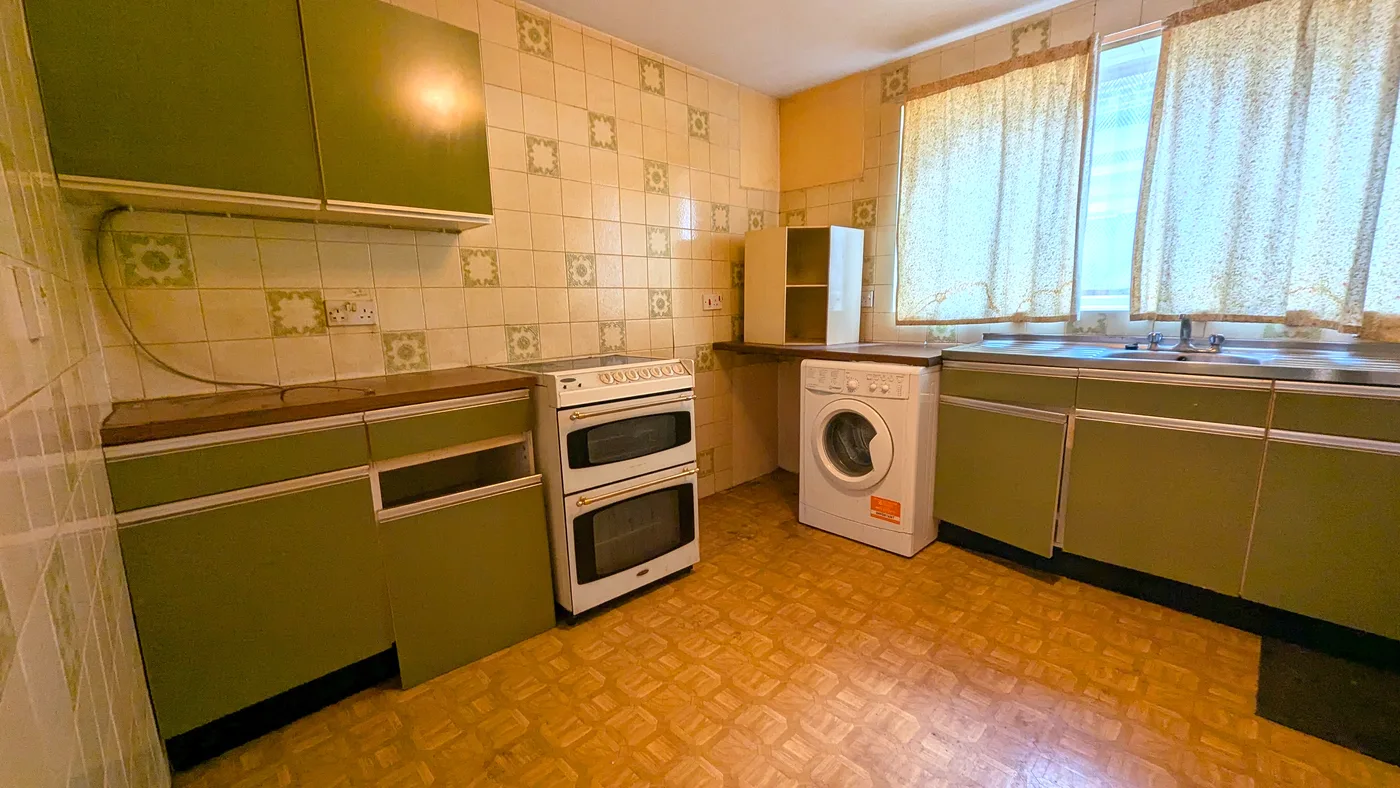
A dated but functional kitchen with olive-green units and patterned wall tiles, cosmetically tired rather than derelict

Selling As-Is: Pros and Cons

An honest as-is sale avoids the cost and risk of pre-sale works. The trade-off is a lower headline price, balanced against certainty and speed.

Advantages

  • No upfront spend on renovations you may not recover
  • Attracts cash buyers, investors and developers who expect it
  • Faster completion times than traditional estate agency sales
  • Lower risk of post-survey renegotiation (condition is priced in)
  • Removes the time and stress of managing works while marketing
  • Transparency reduces the risk of post-completion disputes

Challenges

  • Lower sale price than a renovated equivalent
  • Narrower buyer pool (mortgage restrictions apply to many condition issues)
  • Valuation and survey flags can still stall a conventional sale
  • Requires careful buyer expectation-setting on viewings
  • Estate agents unused to problem properties may mis-price or under-market
  • Some lenders will decline even buyers with a large deposit where the condition is severe

As-is selling is the practical route for flats with material problems that cannot be fixed cheaply. It is less suitable for cosmetically dated flats where a modest presentation budget would widen the buyer pool considerably. The decision turns on how much work is needed and how much of the buyer pool can reasonably be recovered through pre-sale spend.

How Poor Condition Flats Are Priced

Professional buyers price a poor condition flat from the after-repair value (ARV) backwards. They start with what the flat would be worth in good condition and deduct everything they need to cover between purchase and resale or let.

  • After-repair value (ARV): what the flat would fetch, fully renovated, based on comparable sold prices for the same size and location
  • Cost of works: everything needed to reach that condition (structural, systems and cosmetic), including a contingency
  • Holding costs: finance interest, council tax, service charges, insurance and utilities during the works period
  • Transaction costs: stamp duty on purchase, legal fees on both the purchase and the eventual resale
  • Profit margin: the buyer's return for taking on risk, managing the works and tying up capital

What remains after deducting all of the above from the ARV is approximately what a professional buyer will offer. For a flat that would be worth £200,000 in good condition and needs £30,000 of work, a professional buyer might offer £125,000 to £150,000, depending on the buyer's profit margin and holding cost assumptions, not £170,000. The gap is the profit margin plus holding costs plus transaction costs.

From £200,000 finished value to a £127,000 offer

The same worked example as the sidebar, stepped down from the finished value to the offer.

Finished value if fully renovated £200,000

Less cost of works −£30,000

Less holding costs over 9 months −£5,000

Less transaction costs −£8,000

Less the buyer's profit margin −£30,000

Likely offer £127,000

Illustrative figures only. The amber steps are the four deductions a professional buyer makes; each one lowers the level the green bar finally lands on. Change the works estimate or the margin and the offer moves with it.

Setting a realistic price from the outset, based on actual condition rather than hope, leads to a faster sale and reduces the risk of price renegotiation after survey. A survey that turns up problems the buyer was not told about will almost always result in a reduced offer or a withdrawal.

A valuation from a surveyor qualified through the Royal Institution of Chartered Surveyors (RICS), in the current condition and alongside a builder's estimate for the works, gives you a defensible price range. Expect a range rather than a single number: condition of this kind is inherently uncertain until the buyer has the keys.

Who Buys Run-Down Flats?

The buyer pool for a poor condition flat is narrower than for a ready-to-move-in property, but it is well-defined. Understanding who your realistic buyers are shapes how you market, who you market to and how you price.

How condition narrows the buyer pool

Each step down removes a group of buyers, and mortgage buyers go first.

Good condition

Owner-occupiers, first-time buyers, investors: everyone is a possible buyer

Cosmetically dated

Most buyers stay; those wanting move-in ready drop away

Damp or outdated systems

Lenders start applying retentions; cautious buyers withdraw

Structural or derelict

Mortgage buyers are excluded. Cash buyers, investors and developers only

Plus a short lease

Specialist investors who model works and the lease premium together

The widths show the direction of travel, not measured proportions. The practical point is that the further down you sit, the more your marketing has to target investors rather than owner-occupiers.
  • Property investors and buy-to-let landlords: Portfolio builders looking for below-market-value purchases with scope to refurbish and let. They expect a refurbishment discount, have their own contractors and typically pay in cash. Risk-tolerant but numerate: their offer will be calculated, not emotional.
  • Property developers: Buyers with experience of larger refurbishment or conversion projects, often looking to resell rather than let. Particularly interested where scope exists to extend, reconfigure or convert. May pay more than an investor for the right property in an improving area.
  • Quick sale and cash buying companies: Specialists who buy direct from sellers, completing in weeks rather than months. Offers are below open-market value in exchange for certainty and speed. Appropriate where the flat is hard to sell conventionally or where the seller needs to complete quickly.
  • Auction buyers: Mostly experienced investors comfortable with poor condition and leasehold complication. Auction pricing is transparent and terms are disclosed in advance. Completion is within 28 days of the sale. The price achieved is often below a well-run estate agent sale, but the certainty of exchange on auction day has real value.
  • First-time buyers with renovation ambitions: A smaller segment, particularly in areas where good-condition flats are out of reach. Usually mortgage-backed, which means cosmetic-only poor condition works for them but structural issues do not. These buyers tend to look harder and ask more questions than investors, because they are buying an emotional product as well as a financial one.

The practical implication: marketing needs to reach the buyer pool you are realistically targeting. For investor-only properties, an auction or a specialist cash buyer is usually more effective than a high-street estate agent, where viewings from unsuitable buyers consume time without producing offers.

Common Pitfalls When Selling a Flat in Poor Condition

Several patterns come up repeatedly in failed or drawn-out sales of problem properties. Most are avoidable with realistic expectations and preparation.

  • Overpricing on hope: Listing at the good-condition price and waiting for the market to bid. This produces no interest, a slow drift to reductions, and a final sale at a lower price than a realistic initial asking would have achieved.
  • Under-disclosing on the TA6: Claiming "not known" for issues you do know about. This almost always backfires during legal enquiries and survey, damaging the buyer relationship and inviting post-completion claims.
  • Surprise after survey: A buyer who discovers problems during their survey that you did not mention will either renegotiate or withdraw. Either outcome costs weeks and often restarts the process with a new buyer.
  • Using a generalist estate agent: Agents unused to problem properties can mis-price, mis-describe or fail to manage the conveyancing complications that inevitably arise. A specialist in investor sales or auction is usually more effective.
  • Overspending on pre-sale works: Full renovations rarely pay back for investor-targeted properties. Targeted fixes (see earlier section) can pay back; full fit-outs usually do not.
  • Targeting the wrong buyer pool: Marketing to mortgage buyers when the flat is unmortgageable wastes time and money. Match the marketing to the realistic buyer.
  • Mortgage lender restrictions not addressed: Where the flat could be made mortgageable with modest effort (clearing a planning issue, obtaining indemnity insurance, fixing a safety flag), failing to do so unnecessarily limits the buyer pool.
  • Leasehold paperwork delays: The freeholder or managing agent can take weeks or months to produce the management pack. Request it as soon as you decide to sell, not when you have an offer.

Steps to Take When Selling a Run-Down Flat

Two of these are legal requirements rather than good practice: completing the TA6 honestly (step 3) and commissioning an EPC before the flat goes on the market. The rest are optional, but each one shortens the sale or reduces the risk of it falling through.

1. Get a realistic valuation

Commission a RICS valuation in the flat's current condition, not the good-condition value. Pair it with a builder's estimate of the works required. Together these give you a defensible starting point rather than a hopeful one.

2. Choose the right route before marketing

Work out which buyer pool is realistic: estate agency, auction or cash buyer. The route drives everything else: marketing, pricing, solicitor choice and timeline. Picking the wrong route first and then switching late adds months and reduces the final price.

3. Prepare the documents early

TA6, TA7 and the management pack, EPC, building regulations and planning consents, electrical and gas safety records, any existing surveys. Getting these in hand before listing avoids delays later. The leasehold management pack is particularly slow: request it as soon as you decide to sell.

4. Be honest in marketing

Describe the condition clearly in the listing. "Requires full renovation", "sold as seen", "investment opportunity". Honest descriptions attract the right buyers and deter time-wasters. Avoid vague phrases ("needs some work") that invite misunderstanding.

5. Declutter and clean

Even an investor-focused viewer benefits from a clean, empty space where the layout, windows and natural light are visible. Remove rubbish, old furniture and personal items. Skip the cosmetic renovation, but do make the space visible.

6. Highlight redeemable features

Generous proportions, high ceilings, period features, aspect, transport links, regeneration potential. These carry value even in a property that otherwise needs work, and professional buyers weigh them into the ARV.

7. Engage a specialist solicitor

Problem properties produce more legal enquiries than straightforward sales: missing certificates, title defects, service charge disputes, planning issues. A conveyancer who handles these routinely will spot issues early and propose solutions. A high-street generalist may struggle.

8. Plan for negotiation post-survey

Even with honest disclosure, surveys can flag things neither party was fully aware of. Have a plan for how you will respond to survey-driven requests: reduce price, contribute to remediation or hold firm. Going into negotiations without a plan usually weakens the seller's position.

Short Lease and Poor Condition: A Double Challenge

A flat that is both in poor condition and has a short lease is significantly harder to sell through conventional routes. The two issues compound each other: the short lease removes mortgage buyers, and the combined cost of both refurbishment and lease extension is too much for most cash buyers, who would otherwise tolerate one issue but not both.

The buyer pool in this combination is limited to specialist investors who model both the refurbishment cost and the lease extension premium into their offer. That maths often pushes the purchase price well below what a long-lease equivalent in the same condition would achieve, because the investor must fund the extension as well as the works.

In this situation the realistic options are a direct cash buyer who specifically buys difficult leasehold properties, or property auction where the terms are disclosed upfront and buyers know exactly what they are bidding on. An estate agent is unlikely to find a buyer willing to take on both problems at an acceptable price. For more on the lease side of this, see the guide to selling a short lease flat.

Sell Flat UK Buys Flats in Any Condition

We buy unmodernised flats, structurally compromised flats and flats that need complete renovation, including where a short lease makes the situation more complicated. We factor the condition into our offer from the start rather than using it to reduce the price after survey.

No mortgage lender to satisfy, no public viewings, no chain. Where freeholders are slow, where documents are missing or where previous buyers have pulled out, we complete sales that conventional routes cannot.

Unmodernised flats → Unmortgageable flats →

Frequently Asked Questions

Yes, legally. You must disclose known defects via the TA6 property information form and respond honestly to solicitor enquiries. This includes structural issues, damp, water damage, planning violations and anything else you know about. Withholding material information is a legal risk under the Digital Markets, Competition and Consumers Act 2024, which replaced the Consumer Protection from Unfair Trading Regulations 2008 in April 2025, and can result in claims after exchange.

Usually not, if the flat has significant work needed. Most professional buyers (investors, developers, cash buyers) expect to buy at a discount and carry out the work themselves. Selective renovation rarely adds as much value as it costs. Focus on clearing and decluttering, and getting documentation in order rather than spending on cosmetic work that investor buyers will discount anyway.

Property investors and buy-to-let landlords looking for refurbishment projects, property developers, quick sale and cash buying companies, auction buyers and occasionally first-time buyers with a renovation budget. The buyer pool is narrower than for a ready-to-move-in flat, which is why pricing needs to reflect the condition clearly from the outset.

Typically by starting from the after-repair value (ARV), an estimate of what the flat would be worth in good condition, and deducting refurbishment costs, holding costs, transaction costs and the buyer's profit margin. A professional investor will typically apply a larger discount than an individual buyer. Getting a RICS valuation alongside a separate estimate of works helps you understand the realistic price range.

Yes, and auction is often a suitable route. Auction buyers are mostly experienced investors and developers who expect poor condition, price it in, and complete within 28 days of the hammer falling. The price achieved is often below what a well-run estate agent sale would deliver, but the certainty of exchange on auction day has real value when previous conventional sales have collapsed.

It varies widely by route. A cash buyer can complete in 3 to 6 weeks. Auction completes within 28 days of the sale. An estate agency sale typically takes 3 to 6 months, and carries a higher risk of falling through after survey. Flats with severe structural or legal issues can take longer through an estate agent because the mortgage-buyer pool shrinks.

Yes. An Energy Performance Certificate is legally required to market any residential property for sale. Flats in poor condition often score poorly (F or G), which does not prevent sale but matters to buyers who plan to let the property. Rented homes in England and Wales must currently reach at least EPC E, and the Warm Homes Plan confirmed in January 2026 that the minimum rises to EPC C from 1 October 2030. An F or G rating therefore affects what a landlord buyer will pay. If the flat has had no recent EPC, commission one before marketing.

Yes, typically. Cash buyers offer a discount to the open-market price in exchange for certainty, speed and the ability to complete without a lender or a chain. The trade-off is straightforward: a lower price for a faster, more reliable sale. For flats in poor condition where estate agency sales regularly fall through at survey or mortgage stage, the net outcome is often similar once fall-through risk is factored in.

Ready to Get a Cash Offer for Your Flat?

We buy leasehold flats. No estate agent. No public viewings.

Lines open Monday-Friday, 09:00-18:00