
Sellers' Guide
How to Get a Copy of Your Lease, Title Register and Title Plan
Three documents set out what you own in a leasehold flat: the title register, the title plan and the lease itself. The first two cost £7 each and download in minutes. The lease is slower: it comes by post after you send a form and a fee, unless your solicitor, lender or managing agent already holds a copy. This guide explains what each document tells you, where to get it and what to check when it arrives.

Where Do You Get a Copy of Your Lease?
Most leaseholders go years without looking at any of these documents. Then something comes up: a buyer's solicitor asks how many years are left, a neighbour mentions a ground rent review, or you want to know whether the loft is yours. Suddenly the lease matters, and nobody can remember where it is.
The good news is that for a registered flat, which means nearly every flat in England and Wales, the documents are a few clicks away and cost less than a round of drinks. This guide takes the three documents in turn, explains what each one actually tells you and shows where to find it, starting with the free options.

This guide is general information, not legal advice. It covers England and Wales. Scotland and Northern Ireland have their own land registers.
Written and kept up to date by the Sell Flat UK team at LDN Properties Ltd, who have read a great many leases since 2003. Last reviewed on 14 October 2026.
The Three Documents, and What Each One Tells You
People use "the deeds" to mean all of these, but they are different things from different places, and a buyer's solicitor will want all three.
The title register
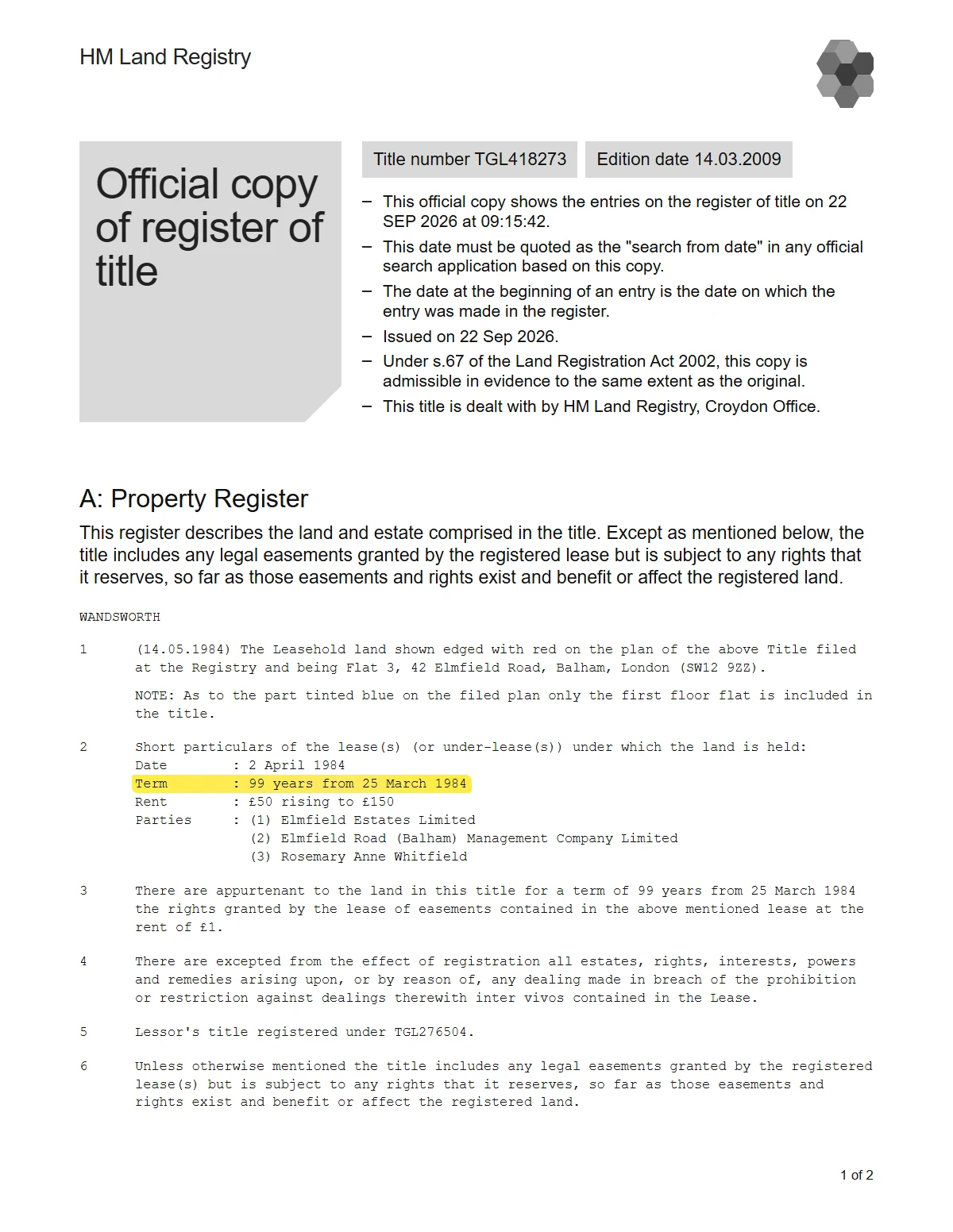
This is HM Land Registry's official record of your leasehold title. It runs to two or three pages in three parts. The property register (part A) describes the flat, names the lease it is held under and gives the lease date, the term and the start date, which is what you need to work out the years left. The proprietorship register (part B) names the owner, the price paid if the flat changed hands after 2000 and any restrictions, such as a requirement to tell the freeholder before a sale is registered. The charges register (part C) lists the mortgage, any notice of a lease extension claim and any deed of variation. A flat has two titles: your leasehold title and the freeholder's title, whose number appears in part A.
The title plan
A single page of Ordnance Survey mapping with the land in the title edged in red. For a flat, the red line usually goes round the whole building, with a note saying which floor or which part is included, because the map cannot show one floor of a building. It tells you where the building is and roughly what is in the title. It does not show the layout of your flat. That is the job of the plan attached to the lease.
The lease
The contract itself: anything from 20 to 80 pages setting out what you own, what the freeholder keeps, who repairs what, what you pay, what you may and may not do and, at the back, a plan of the flat with your demise coloured or edged. Every lease was signed in two copies when it was granted. The original went to the first leaseholder and has passed down with the flat. The counterpart, signed by the leaseholder, stayed with the freeholder. HM Land Registry usually holds a scanned copy as well. Our guide on how to read your lease explains what to look for once you have it.
Step 1: Find Your Title Number
Everything else hangs off the title number, a code of letters and digits such as TGL418273. You will find it on any old official copy, on the completion statement from when you bought, or on your mortgage offer. If none of those is to hand, the search is free.
- Go to the GOV.UK service "Search for land and property information". It is run by HM Land Registry. Avoid the lookalike sites that come top of a web search and charge £20 or more for the same document.
- Search by postcode and pick your flat. The results list every title at the address. A flat usually shows two or more: the freehold of the building and a leasehold title for each flat. Yours is the one marked leasehold at your flat number.
- Note the title number. You can see it and the tenure before paying anything.
If the search finds no leasehold title for your flat, the lease may be unregistered. That is rare now, since every sale since 1990 has triggered registration, but it still happens with flats that have not changed hands for decades. The section on missing documents covers it.
Step 2: Get the Title Register
From the same search result, choose the title register and pay £7 by card. The document downloads as a PDF straight away. It is an online copy, not an official one: it shows the position on the day you downloaded it, which is all you need for your own checking, but it cannot be used as proof of ownership. Official copies cost £11 by post.
That last point matters for a sale. Your solicitor will order a fresh official copy when the sale starts, because the buyer's solicitor wants one that is recent. The copy you buy now is for your own checking. There is no need to buy it twice, and no need to buy it at all if your solicitor is about to.
Step 3: Get the Title Plan
Same service, same price: £7 and an instant PDF. For most flat sellers the plan answers one question, which is whether the red edging takes in the whole building or something odd, such as a garden, a garage or a bin store that the lease plan also needs to show. If the title plan and the lease plan disagree about what you own, that is worth knowing before a buyer's solicitor finds it, and our guide to selling with a defective lease covers what happens next.
Step 4: Get a Copy of the Lease
This is the one that takes effort, so start with the places where it might already be sitting.
The free options
- Your own paperwork. When you bought, your solicitor sent you a completion pack, often a folder or a PDF bundle. The lease, or a certified copy, is usually in it.
- The solicitor who acted for you. Firms keep conveyancing files for at least six years and often longer, and a copy of the lease is in the file. One email usually does it, though a firm that has since closed or merged can take some tracking down.
- Your mortgage lender. Lenders no longer hold paper deeds for registered flats, but some still have the lease on file from when the mortgage was taken out.
- The freeholder or managing agent. They hold the counterpart, and many will send a copy for a small administration fee, sometimes nothing. The leases of the other flats in a block are usually in the same form, so a neighbour's copy will tell you most of what you need in the meantime.
From HM Land Registry
If none of those produces it, the register will tell you whether HM Land Registry has a copy. Look at part A for the words "filed" or "copy filed" against the lease. If they are there, the Registry holds a scanned copy and will send you an official copy.
- Download form OC2, "Application for official copies of documents", from GOV.UK and fill it in with your title number and the lease date from the register.
- Enclose the fee, which is £11 for each document, by cheque or postal order payable to HM Land Registry. The lease and any deed of variation count as separate documents.
- Post it to HM Land Registry Citizen Centre, PO Box 7806, Bilston WV1 9QR. The copy comes back by post, so allow a couple of weeks rather than a couple of days.
Members of the public cannot order filed documents online. Solicitors, managing agents and other businesses with HM Land Registry's e-services can, and they download the lease for £7, usually within minutes. If you are already instructing a solicitor for the sale, or your managing agent has an account, asking them to pull the lease is quicker and cheaper than doing it yourself.
If Nobody Has a Copy
Occasionally the register says nothing about a filed copy, HM Land Registry writes back to say it holds no copy, the old solicitor's file has been destroyed and the freeholder cannot find the counterpart. That is a problem for a sale, because the buyer's solicitor cannot advise on a lease they cannot read, and a lender will not lend without one.
There are ways through, and your solicitor should lead them. The freeholder's own title often has the lease, or an earlier version of it, filed against it. Neighbouring flats in the same block will have leases in the same form, which can be used to reconstruct yours. Where the lease really has gone, the freeholder and leaseholder can enter into a deed confirming its terms, or in the last resort grant a replacement. Each of these takes weeks to months, and a buyer needs to know early that it is happening. Where the lease is unregistered as well as missing, the sale will trigger first registration, and your solicitor will need whatever evidence of the lease exists, including the freeholder's counterpart.
What to Check When the Documents Arrive
Five minutes with each document answers most of the questions a buyer's solicitor will ask later:
- The term and start date in part A of the register. Count forward from the start date, not from when you bought, to find the years left. Below 80 years, the cost of a lease extension steps up sharply.
- The ground rent in part A and in the lease, and whether it rises on a fixed schedule or by a formula. A doubling clause will come up in the sale, and our guide to ground rent problems explains how.
- Restrictions in part B. A restriction requiring the freeholder's certificate before a transfer is registered means the freeholder has to be paid and asked to sign something on completion, which takes time.
- Entries in part C besides your mortgage: a notice of a lease extension claim, a deed of variation, or anything you do not recognise.
- The lease plan against the flat. Walk round with it. Loft, cellar, garden, parking space, bin store: if you use it, is it in the demise?
- The repairing clauses and the service charge percentage, which decide who pays for the roof and how much of it is yours. Our guide to reading your lease walks through them.
What a Sale Actually Needs
Your solicitor will obtain official copies of the register and plan when the sale starts, and will get the lease from your completion pack, from the Registry or from the freeholder. The buyer's solicitor will do the same on their side. None of this is something you need to pay for yourself.
The reason to get the documents now is to read them before a buyer's solicitor does. Most of the problems that slow leasehold sales, a short term, a rising ground rent, a demise that does not match the flat, a missing lease, show up in these three documents. Finding them in week one, with time to fix or price them, is a different sale from finding them in week eight. Our pre-listing checklist sets out the other paperwork to gather alongside them.
Sources and Further Reading
- GOV.UK: Search for land and property information: the official service for the title register and title plan.
- GOV.UK: Get information about property and land, copies of deeds: how to request filed documents on form OC2, the £11 fee and the postal address.
- HM Land Registry: form OC2: the application form for official copies of documents.
- HM Land Registry: information services fees: the current £7 online and £11 postal fees, in force since 9 December 2024.
- Leasehold Advisory Service: get a copy of your lease: the free options and what to do if the lease is lost.
Frequently Asked Questions
The title register and title plan cost £7 each from HM Land Registry's online service and download at once. A copy of the lease itself costs £11 by post, requested on form OC2, provided the Registry holds a scanned copy. Before paying, check your completion paperwork and ask the solicitor who acted when you bought, because a copy of the lease is usually in that file and costs nothing.
The title register is HM Land Registry's two or three page summary of your leasehold title: the flat, the lease date and term, the owner, any restrictions and any mortgage. The lease is the full contract, often 20 to 80 pages, setting out what you own, who repairs what, what you pay and the rules you live under, with a plan of the flat at the back. A buyer's solicitor needs both, and the plan that comes with the register is a map of the building, not of your flat.
Not as a member of the public. The register and plan are online for £7 each, but filed documents such as the lease have to be requested by post on form OC2 for £11, and the copy comes back by post. Solicitors, managing agents and other businesses with HM Land Registry's e-services can download the lease for £7, usually within minutes, so if you are already instructing a solicitor or your managing agent has an account, asking them is quicker and cheaper.
It appears on any old official copy, on the completion statement from when you bought and often on your mortgage offer. If you do not have any of those, search by postcode on the GOV.UK service "Search for land and property information". The results show every title at the address, including the freehold of the building and a leasehold title for each flat, and you can see the title number and tenure before paying.
Usually, but not always. Look in part A of the title register for the words "filed" or "copy filed" against the lease. If they are there, the Registry holds a scanned copy. If not, it may still hold one, but if your OC2 application finds nothing the Registry will tell you so. The Registry does not keep original paper deeds, so the signed original is with whoever holds your flat's paperwork and the counterpart is with the freeholder.
Every lease was signed in two copies. The original, signed by the freeholder, went to the first leaseholder and has passed down with the flat, so it is with your paperwork, your solicitor's file or, occasionally, your lender. The counterpart, signed by the leaseholder, stayed with the freeholder or their managing agent. Either copy, or HM Land Registry's scanned copy, is good enough for a sale.
Start with the freeholder's counterpart and the leases of neighbouring flats, which are normally in the same form. HM Land Registry may hold a copy against the freeholder's title even if not against yours. Where no copy exists anywhere, the freeholder and leaseholder can sign a deed confirming the lease terms or, in the last resort, grant a replacement lease. Your solicitor should lead this, and a buyer needs to know early that it is in hand.
No. Your solicitor will order official copies of the register and plan when the sale starts and will get the lease from your completion pack, the Registry or the freeholder. The reason to get them now is to read them yourself before a buyer's solicitor does, so that a short term, a rising ground rent or a plan that does not match the flat is found in week one rather than week eight.
They are different things. The title plan is a page of Ordnance Survey mapping with the land in the title edged in red, which for a flat usually means the whole building with a note about which floor is included. The lease plan is a drawing of your flat showing exactly what is demised to you. If the two disagree about something such as a garden or a parking space, that is worth raising with your solicitor before you go to market.
They are resellers. They order the same £7 online copy from HM Land Registry and add their own fee. Some appear above the official service in search results. Use the GOV.UK service, which is the only one run by HM Land Registry, and you pay £7 for the register and £7 for the plan.