
News · 13 August 2026
Free Tool Shows Your Lease Length and What Extending Will Cost
The Leasehold Advisory Service has merged its lease length checker and its extension cost calculator into a single free service built on HM Land Registry data. Here is how it works, and what it can tell you about your own lease.

Paying £7 just to check the length of your flat's lease is now a thing of the past. A new service lets you check your lease length for free.
Good news for anyone who is unsure how many years are left on their lease. The Leasehold Advisory Service (LEASE), the government-funded body that provides free advice to leaseholders, has combined two of its online tools into one.
The LEASE lease extension calculator is free to use and takes just a couple of minutes. It first tells you exactly how much time is left on your lease, then gives you an estimate of what a lease extension could cost.
LEASE launched a free standalone lease-length checker in February 2026, while its premium calculator has been available for several years. The difference now is that the two tools work as one continuous process. The lease length is looked up first and carried straight through to the cost estimate, so you no longer need to know how many years are left before you begin.
The lease-length lookup is the one that really matters. Premium calculators have existed for years and most are freely available, so that side breaks no new ground. Being able to read the Land Registry lease term without paying for it is the more useful development by some distance.
At the end, the tool provides guidance tailored to your circumstances, including whether you may need to take action yet. You can also email yourself a copy of the finished report.
Kion Ahadi, chief executive of LEASE, said the tool "gives leaseholders a simple way to understand where they stand", adding that "many leaseholders are unaware of the importance of their lease length until they come to sell, remortgage or consider extending their lease".
The 80-year mark is particularly important for leaseholders. Once a lease drops below 80 years, an additional cost known as marriage value is added to the premium for extending it, which can make the extension significantly more expensive. The tool is designed with that threshold in mind: it shows how close your lease is to 80 years, explains marriage value in straightforward terms and, if you continue to the cost estimate, shows how the price could change if you leave the extension for a few more years.
And it is not only for existing owners. At step four, the tool asks whether you own and live in the flat, own it but let it out, are considering buying it or are a property professional such as a solicitor, surveyor or estate agent, with an "Other" option for anyone who does not fit. Anyone can use it to check a leasehold address in England and Wales.
What the Tool Actually Tells You
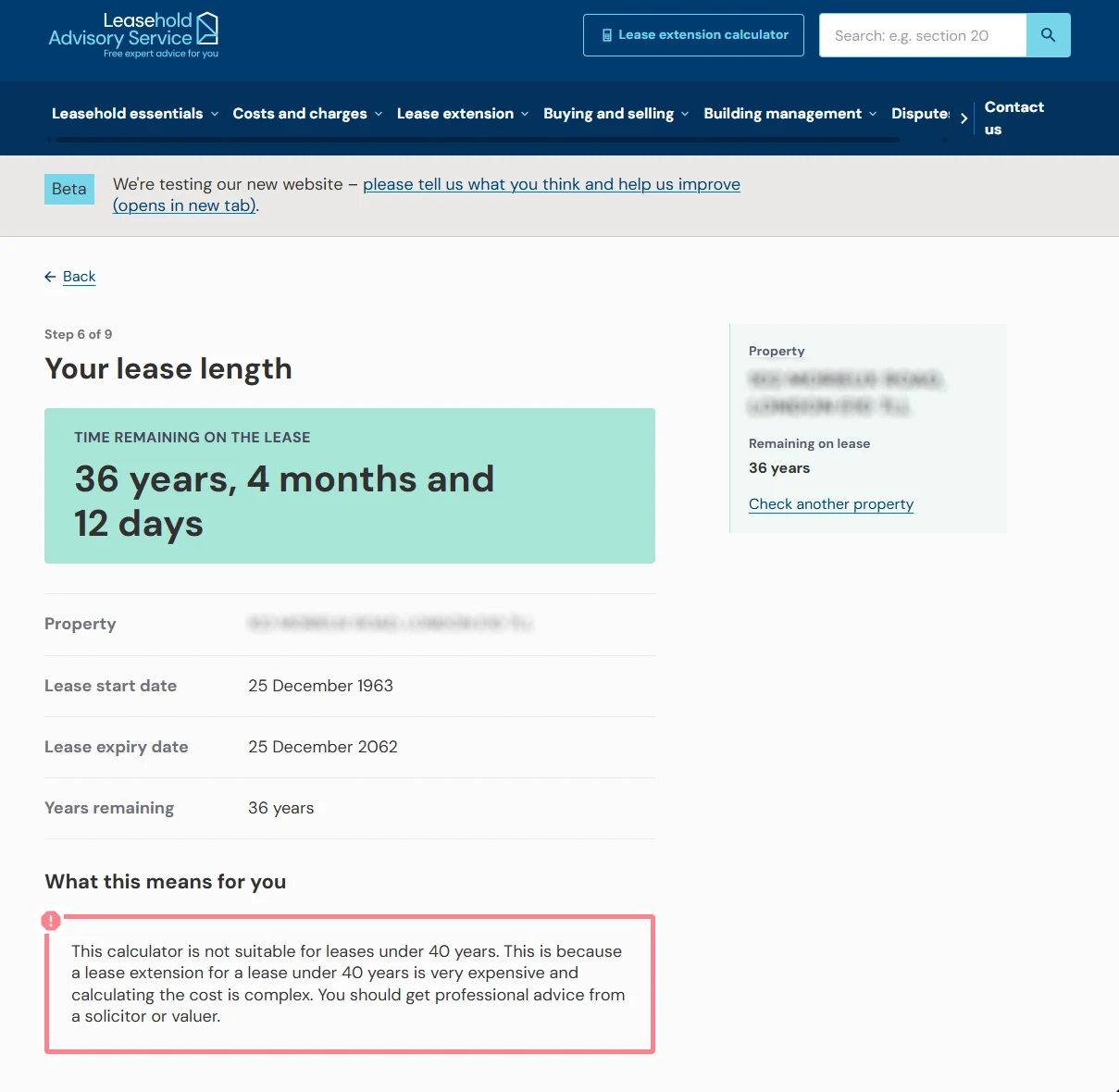
The lease length page is what most people will come for, and it returns three things: the date the lease started, the date it expires and the time left, down to the day.
That last detail sounds like a flourish, and on a lease with a century to run it is. Near a threshold it is not. A flat with 80 years and two months left sits in a different position from one with 79 years and ten months, since dropping below 80 years brings marriage value into the extension premium and pushes the cost up sharply. Knowing you have two months rather than "about 80 years" is the difference between acting and missing it.
The figures come from HM Land Registry. LEASE says it has to verify your identity and log your IP address in order to access that lease data, which is the reason it asks for an email address and sends a confirmation code before showing you anything.
How It Works
Nine steps, in this order:
- Steps 1 to 3, finding the flat. You enter a full postcode and pick your property from the leasehold titles found at that address. If you already know your lease length, step one lets you skip the lookup and type it in yourself.
- Steps 4 and 5, proving you are real. You give an email address and enter a six-digit code sent to it. LEASE explains why: it has to verify identity and store your IP address to access Land Registry lease data. It also states it will not use the address for marketing, and the newsletter sign-up at the end is a separate tick box.
- Step 6, your lease length. The dates and the exact time remaining, with a plain-English note on what that length means for you.
- Steps 7 and 8, the two figures you supply. What the flat would be worth with a very long lease, and your annual ground rent. The ground rent question is handled well: it spells out that this is not your service charge and tells you where to find it, in the early sections of your lease or on a recent demand. You can tick "I don't know my ground rent" and carry on with a less accurate estimate.
- Step 9, the estimate. A premium range for a 90-year statutory extension, with the reasoning behind it available to expand.
What Waiting Would Cost You
The final page does the most useful thing in the whole tool. Alongside today's estimate it projects what the same extension would cost if you put it off, which turns an abstract warning about the 80-year threshold into a number.
Take a lease with 101 years remaining, run through the tool. Extending today comes out at £1,000 to £2,000, based on a calculated figure of £1,500. Leave it 22 years and the lease drops to 79 years, below the threshold, and the estimate jumps to £13,000. That is £11,500 more for waiting.
| If you wait | Years remaining | Estimated premium | More than today |
|---|---|---|---|
| 1 year | 100 | £1,500 | No change |
| 3 years | 98 | £2,000 | £500 |
| 5 years | 96 | £2,000 | £500 |
| 10 years | 91 | £2,500 | £1,000 |
| 15 years | 86 | £2,500 | £1,000 |
| 22 years | 79 | £13,000 | £11,500 |
The shape of that table makes the case for checking your lease early. For years, the cost of extending may change only gradually. Then, once the lease drops below 80 years, the premium can rise much more sharply.
Marriage value is the reason. Below the 80-year threshold, the leaseholder must pay the freeholder a share of the additional value created by the lease extension, on top of the basic premium. Our guide to marriage value explains how that calculation works in more detail.
A significant number of leaseholders are closer to that threshold than they may realise. Analysis of lease data by LEASE, processed by the Open Data Institute, found that around 8% of residential leases in England and Wales have between 80 and 90 years remaining. Of those, 41% are in London and a further 16% are in the South East.
Where the Tool Stops
LEASE is also clear about the calculator's limitations, and they are worth understanding if you plan to rely on the estimate:
- It will not price leases with fewer than 40 years remaining. The tool will tell you the lease length, but it stops there. LEASE's view is that extending a lease this short (under 40 years) is sufficiently expensive and complex that you should seek advice from a solicitor or specialist valuer. In that sense, the absence of an estimate is useful information in itself.
- It is an estimate, not a valuation. The example above comes with a margin of plus or minus 12.5%, and LEASE specifically warns against using the figure as the basis for negotiations with a freeholder.
- Legal and professional fees are excluded. The figure covers the premium paid to the freeholder for the lease extension. Your own solicitor and valuer, as well as the freeholder's reasonable legal and valuation costs, are additional.
- It models the statutory route only. The calculator assumes a formal 90-year lease extension. You can negotiate an informal extension directly with the freeholder, and that may sometimes appear cheaper, but the terms can be less favourable. The calculator does not try to model those deals.
- Recent lease extensions may not appear immediately. The first step warns that Land Registry records can take time to update, so a recently extended lease may still show its old term.
- The tool is still in beta. LEASE is actively asking users for feedback, so some of the wording, assumptions and functionality may change as the service develops.
There is also a broader caveat behind all of these figures. The calculator works from the leasehold rules currently in force. The Leasehold and Freehold Reform Act 2024 includes provisions that would abolish marriage value and change the way lease-extension premiums are calculated. Until those changes are brought into force, however, the calculator reflects the existing system, so its estimates are based on the rules that apply today.
What This Means If You Are Selling
Three practical consequences, if a sale is on the horizon.
The first is that there is now no excuse for going to market without knowing your exact lease length. It has to appear in the listing anyway: since April 2025 the Digital Markets, Competition and Consumers Act 2024 has required estate agents to put material information, lease length included, in the advert itself. Finding the number at listing stage rather than six weeks into conveyancing removes one of the more common causes of a collapsed sale.
The second works in the buyer's favour. A buyer can now look up the lease on your flat before they book a viewing, and so can their solicitor or agent. Describing a flat as having a "long lease" in the hope that nobody checks was never a good plan; it is now a pointless one.
The third applies if the tool declines to give you a cost. A lease under 40 years puts your flat well outside mainstream mortgage lending, which narrows the realistic buyer pool to cash buyers and the auction room. Our guides to selling a short lease flat and selling to a cash buyer cover what that means for price and timescale.
Our View
This is a positive development, and the real value is the transparency. None of the underlying information was ever secret. Your lease length has always been recorded on the Land Registry title, while marriage value has been part of leasehold law since the Leasehold Reform, Housing and Urban Development Act 1993. The problem was access. You had to know the register existed, know what to look for, pay to download the title and then understand what the remaining term actually meant for you.
Until now, a leaseholder who simply wanted to know how many years were left had two options: pay £7 to download the title register from HM Land Registry, or ask a solicitor to check and pay for their time. Neither is a large sum, but removing that barrier is the genuinely significant part of what LEASE has built. The cost calculator, useful as it is, is nothing new.
That matters because leasehold has long been a market in which one side tends to know more than the other. Freeholders, managing agents and the professionals advising them understand where the important thresholds sit. Leaseholders often discover them much later, sometimes from a buyer's solicitor, which is about the worst possible moment to learn that the lease dropped below 80 years three years earlier.
A tool that gives you an authoritative lease length, shows the dates behind it and explains how the cost estimate has been calculated helps narrow that information gap. It also gives prospective buyers access to the same facts. That seems a healthy thing for the market: when both sides can check the same information at the outset, there is less scope for expensive surprises later in the transaction.
In practical terms, a leaseholder can now find out how long is left on their lease and get a rough idea of the cost of extending it in a couple of minutes, without paying anything or waiting for a managing agent to respond. The projection showing how the cost could rise if you wait is particularly useful, because the 80-year threshold is one of the most financially significant features of leasehold, and one that many owners only learn about after they have crossed it.
The important thing is to treat the calculator as the start of the conversation, not the end of it. The lease length itself is based on the Land Registry record. The premium is only an estimate. Once significant money is involved, whether you are negotiating an extension with a freeholder, deciding when to extend or pricing a flat for sale, that is the point at which specialist advice from a valuer familiar with the building and the local market becomes worthwhile.
What the tool does well is help you work out whether you need to have that conversation in the first place. For a free service, that is exactly the job it should be doing.
You can run a check using the LEASE lease extension calculator. If you would prefer to work through the detail yourself first, our guide to checking how many years are left on your lease explains the other ways to confirm the figure, while our guide to how to extend your lease covers what happens next.